
Half-Mast Murder begins at Cliff’s End, Professor Henry Paley’s seaside estate. The setting is not ornamental. The house, terrace, gardens, tennis court, cliff path, and detached octagonal summer house create possible routes—and possible mistakes about those routes.
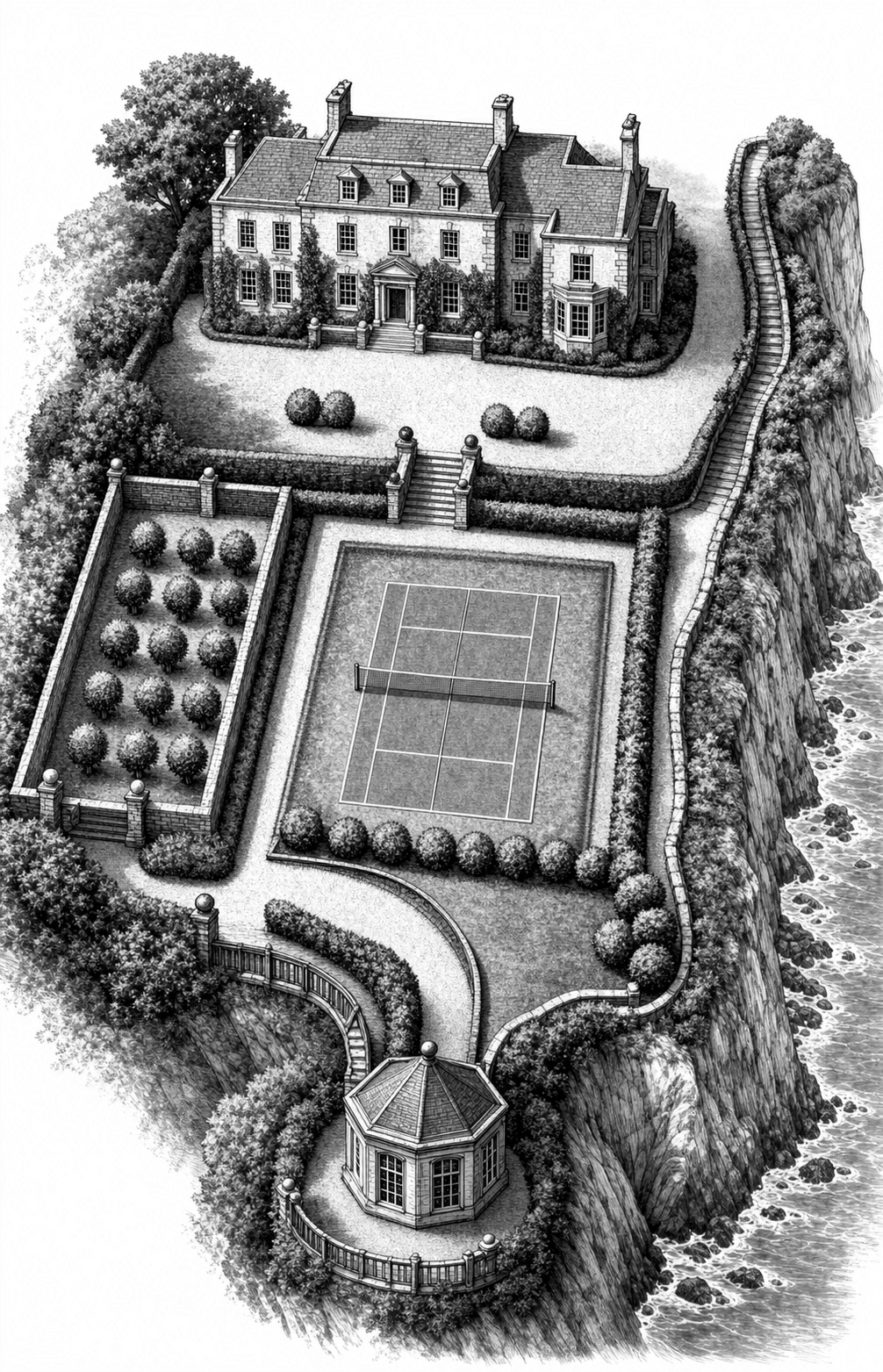
The household at a glance
- Professor Henry “Harry” Paley owns Cliff’s End. He is a historian and political writer.
- Mrs. Mary Arkwright, Paley’s widowed sister, acts as hostess.
- Cynthia and Julian Paley are Paley’s niece and nephew.
- George Shipman is a guest closely attached to Cynthia.
- Herbert “Bertie” Trent is a writer and an old family friend.
- Richards is the longtime butler whose knowledge of household routine matters.
- Bartholomew Quirk is an American visitor carrying a letter of introduction.
The investigation
Superintendent Guest leads the local inquiry, assisted by Sergeant Grimmett. Major Dillon is the county chief constable. Kennedy is interested in professional boundaries: what a local officer can establish, how statements are tested, and how respectability affects the reception of a claim.
Keep separate what the police directly observe, what a witness reports, and what one character repeats from another. A fair-play mystery often hides uncertainty inside ordinary grammar.
Five things to track
- Routes: which path connects the house and summer house, and what can be seen along it?
- Timing: how long should a walk, message, or journey take?
- Documents: letters, signatures, registers, and introductions deserve the same attention as physical clues.
- Names: Kennedy uses formal names, nicknames, titles, and one brief mishearing. Notice who knows which version.
- Household visibility: servants and guests occupy the same space differently. A person overlooked socially may still be an exact observer.
Editorial name note: the original edition calls Herbert Trent “Edward Trent” in four later passages. Because he introduces himself as Herbert, is consistently Bertie, and no separate Edward appears, the Clever Girl edition regularizes those references to Herbert.
How to read a fair-play puzzle
You do not need to build an enormous clue ledger. Pause when testimony changes, when a practical detail receives unusual emphasis, or when an apparently settled fact depends on only one source. The pleasure lies as much in testing the shape of the explanation as in naming a culprit.
Continue with the book
- Half-Mast Murder: annotated Kindle and paperback editions
- Half-Mast Murder and the history of “whodunit”
- Clever Girl Press spoiler-free introduction, character guide, and estate-map research.