
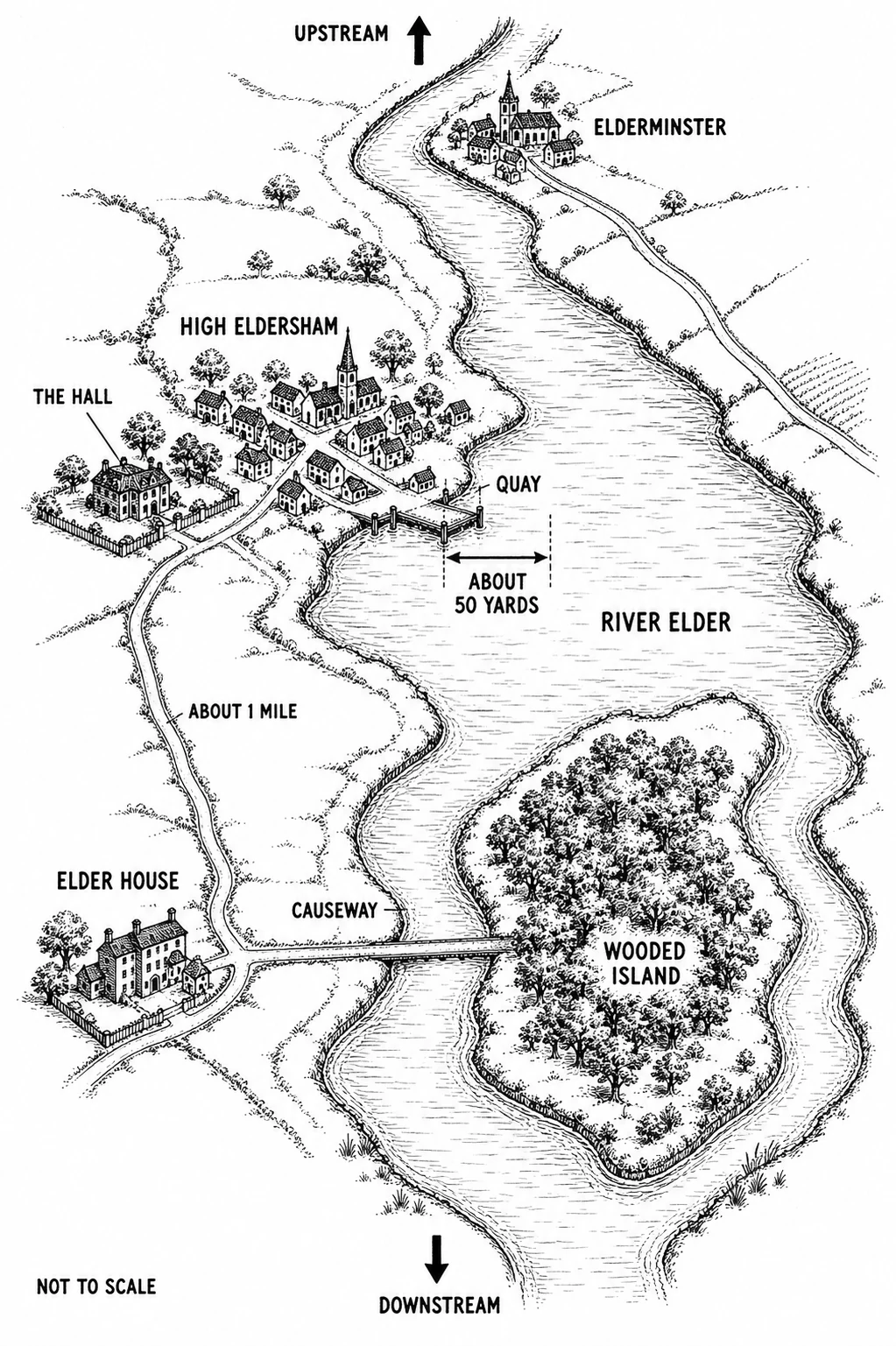
High Eldersham stands beside the River Elder in an imagined East Anglian district. The Rose and Crown, a lonely village inn, provides the novel’s opening center. The Hall, the quay, Elder House, a wooded island, and the upriver town of Elderminster expand the investigation outward.
Reading the village and river district
- High Eldersham and the quay: the village stands beside the Elder, which is about fifty yards wide at the quay.
- The Hall: the Owerton family seat lies in the village district.
- Elder House: Hollesley’s residence is described as about a mile away and connected with the river district.
- Wooded island and causeway: branches of the Elder surround an approach difficult to observe from outside.
- Elderminster: the upriver destination establishes the Elder as a working waterway rather than a decorative stream.
From the river to the coast
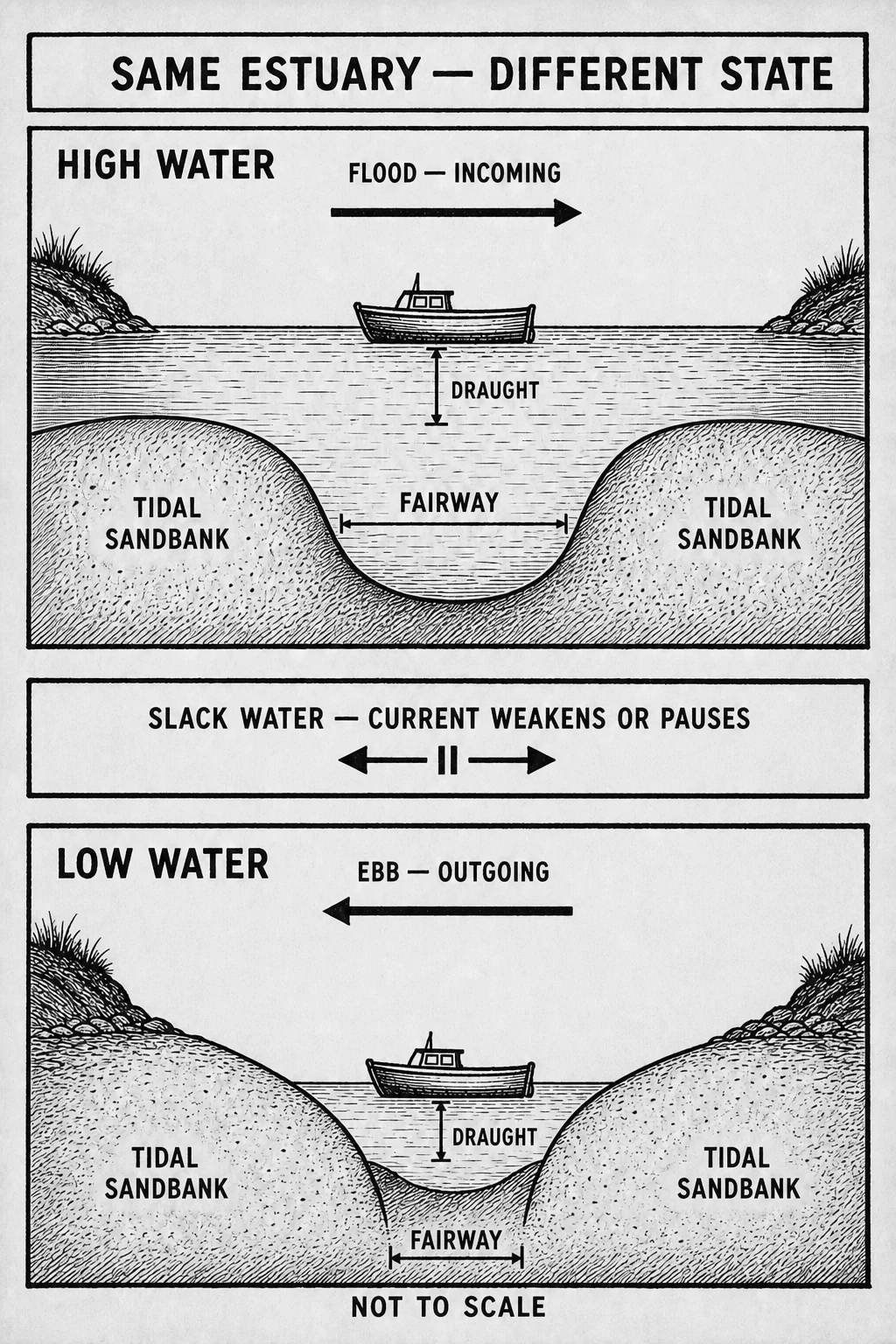
The lower Elder reaches the coast near a lagoon and a shallow tidal approach. A fairway marks the usable channel. Vane Sand lies offshore, covered at high water and exposed at low water. A route that is safe at one hour may be dangerously shallow later.
Five nautical terms that clarify the action
- Flood: the incoming tidal current.
- Ebb: the outgoing tidal current.
- Slack water: the interval near a turn when the current weakens or pauses.
- Draught: the depth of water a vessel needs below its waterline.
- Fairway: the navigable channel through shallow or obstructed water.
Tide controls access; draught controls which vessel can use that access. Bearings and measured distances allow an observer to fix a position and find it again. Burton expects these practical details to carry investigative weight.
Folklore and a 1930 intellectual setting
The novel also appeared during the popular influence of Margaret Murray’s The Witch-Cult in Western Europe. Murray argued that witch-trial testimony preserved evidence of an organized pre-Christian religion. Modern historians do not accept that survival thesis: trial records were shaped by legal pressure, theological expectation, suggestion, and sometimes torture.
Keeping both periods in view prevents a common mistake. Burton’s readers could encounter Murray’s ideas as current cultural material in 1930; that does not make the theory reliable history today.
Spoiler boundary: these maps show stated geography and general navigation only. They omit solution mechanics and do not identify what any location ultimately means to the case.
Sources and further reading
- Clever Girl Press, spoiler-free geography reconstruction, tide explainer, and historical scholarship note for the annotated edition.
- Meet Miles Burton, Cecil Street, and Desmond Merrion
- The Secret of High Eldersham annotated edition